Grounded in Science
A balance of research news and well-being for the Usher syndrome community.
May is Mental Health Awareness Month. This is a time to raise awareness, foster open conversations, and reduce the stigma surrounding mental health.
The World Health Organization defines mental health as "a state of well-being in which an individual realizes their own abilities, can cope with the normal stresses of life, can work productively and fruitfully, and is able to make a contribution to their community."
Children and adults living with Usher syndrome are vibrant, active, and contributing members of their communities. At the same time, many of you have told us through your questions, your stories, and your concerns that the progressive and unpredictable nature of vision loss that is a hallmark of Usher can significantly impact well-being.
While published research specifically on Usher syndrome and mental health remains limited, your experiences make clear that this is an important part of life with Usher.
At the Usher Syndrome Coalition, we want you to know: you are not alone. Our passion is building and supporting the Usher community. We are equally focused on identifying and creating resources to support you, while bringing together the research community and the experts living with Usher syndrome.
Our website offers a growing list of resources, including community connections, presentations, and more, shared with us by the community.
RESEARCH SPOTLIGHT: Sepul Bio by Thea, LUNA Clinical Trial
Big news for the Usher syndrome community - a major milestone is here! Thanks to the support of the Usher Syndrome Coalition, the USH Trust, and many community members, the Phase 2 LUNA clinical study is closing recruitment. This means enough people have enrolled, or are enrolling in the coming months, allowing Sepul Bio by Thea to move forward with the research.
What is a clinical study? A clinical study (also called a clinical trial) is a carefully designed research project where scientists test whether a new treatment is safe and effective for patients. The LUNA study is testing a drug called ultevursen to see if it can help people with a specific type of vision loss called retinitis pigmentosa (RP) - a condition where the photoreceptors, or light-sensitive cells, in the eye slowly stop working over time.
This particular study is for people whose RP is caused by genetic changes, called variants, in a specific section (called exon 13) of the USH2A gene. Genes are like instruction manuals inside our cells. When part of an instruction is written incorrectly, it can cause health conditions like Usher syndrome. The LUNA study will enroll 81 adults and children over age 8 (or 12 and older in Europe) who have this specific genetic variant.
The study is also double-masked and randomized, which are important scientific terms. "Randomized" means participants are randomly placed into two groups. One group receives the real treatment, others receive a sham (also known as a placebo or an inactive treatment). "Double-masked" means neither the patients nor the doctors know who received which one. This helps make sure the results are fair and accurate.
Why is enrollment so important and so hard? Finding enough participants for a clinical trial is one of the biggest challenges in medical research, especially for rare diseases like Usher syndrome, where fewer people are affected. We've seen in other diseases like multiple sclerosis and cystic fibrosis, that when patients organize and share their information, they can actually help move forward the development of new treatments. That's incredibly powerful.
To tackle this challenge, Sepul Bio and the Usher Syndrome Coalition worked closely together to connect USH2A families with top research centers around the world. The study enrolled participants from ten countries: Brazil, Belgium, Canada, Denmark, France, Germany, Italy, the Netherlands, the United Kingdom, and the United States.
How did the USH Trust help? A patient registry is a database where people with a specific condition can sign up and share information about their health and genetics. The USH Trust was a key tool in finding the right participants for the LUNA study. Because the trial is gene-specific, meaning it only applies to people with the exact USH2A exon 13 variant, knowing your own genetics is crucial. The USH Trust helped hundreds of USH2A families learn about this opportunity, leading to over 95 direct referrals to clinical sites. It also inspired many families to learn more about their own genetics, which will be important for future research too.
“The USH Trust played a crucial role in helping the research team reach a highly relevant and engaged USH2A exon 13 community, significantly enhancing both the effectiveness and educated nature of the recruitment project. It has been positive to see how engaged and informed the community has become. Being part of the USH Trust has led to a lot of the community knowing their own genetics. This plays a key role in enrolling in clinical research, such as the LUNA clinical study, which is gene-specific. However, it has also been heartening to see motivated USH families want to know more about their own genetics and how to enroll in future research. Knowing your gene and the causes of your Usher syndrome play a central role in engaging with research like that of Sepul Bio.”
- Andrew Bolan, Patient Advocacy Director, Sepul Bio
What happens next? It took 18 months to fully recruit for the LUNA study, starting with the first participant in Dallas, Texas. Now that recruitment is closing, the research teams can focus on running the study and analyzing the results. After this Phase 2 study is complete, the next step will be a Phase 3 trial, the final phase before a treatment can be considered for approval. That phase will need even more community members to participate.
The Usher Coalition is deeply grateful to everyone who considered or joined this study. Every person who participates in research like this helps bring the whole community closer to better treatments.
Want to learn more about how clinical trials work? Visit: https://www.usher-syndrome.org/research/clinical-trials.html
Check out our Current USH Research page specific to USH subtype as well as other gene-independent therapeutic approaches.
Join the USH Trust to stay updated on clinical trials and opportunities to participate. Only ten questions need to be answered to register.
ARVO 2026 Update from Executive Director Krista Vasi
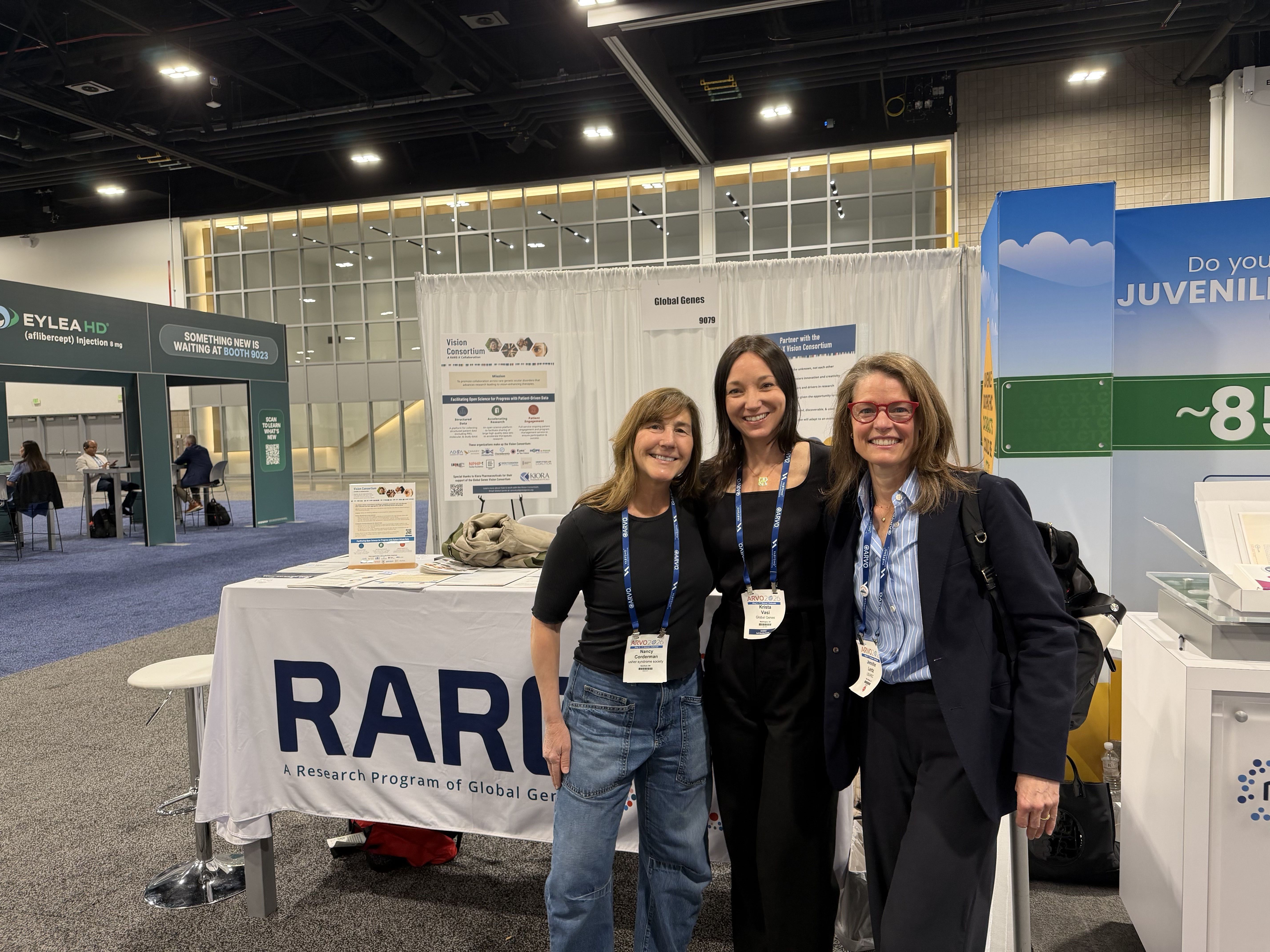
ID: (L to R) Nancy, Krista, and Jennifer stand together, smiling at the camera. Convention hall and booths are in the background.
"I just spent five days in Denver at ARVO, the annual meeting of the Association for Research in Vision and Ophthalmology, and the largest gathering of eye and vision researchers in the world. I also attended the Foundation Fighting Blindness Retinal Innovations Summit for the first time. It won’t be my last.
What I kept coming back to, sitting in those rooms: the science is here. Hundreds of researchers are making real progress toward treatments for inherited retinal diseases, including Usher syndrome. The pace of discovery is remarkable.
What is not yet here, not in anywhere near the measure this community needs, is the funding and resources to match.
This photo was taken at the RARE-X Vision Consortium booth at ARVO, where I represented the Usher Syndrome Coalition as a member of the Vision Consortium. The Usher syndrome world is small and deeply connected – pictured here with Nancy Corderman, who founded the Usher Syndrome Society and serves on our board, and Dr. Jennifer Lentz, USH researcher and Coalition board member. Meetings like this one have a way of generating exactly the kind of connections that move research forward. This week was no exception, with exciting new collaborations already taking shape.
Next week I’ll be on Capitol Hill for our USH Advocacy Days, making the case for $50 million in dedicated federal funding for Usher syndrome research through the U.S.H.E.R. Research Program at NIH. The science is ready. The researchers are ready. The community has been ready for a long time.
On Well-Being: Rekindled Hope
USH Community Connections: Nadia from Egypt
"The Usher Syndrome Coalition serves as a bridge through which we can reach solutions. Connecting with the Usher community has instilled in me the belief that it is indeed possible for people to come together - to offer mutual support and stand united - in order to create hope for themselves and for others.
It is my hope that researchers will discover a cure for those living with this syndrome. Furthermore, I wish for others to understand that when interacting with individuals who have Usher syndrome, these are people capable of achieving the seemingly impossible, provided they receive the necessary rehabilitation and preparation for what lies ahead.
I was deeply pained the moment I learned that both my sister and her son have Usher syndrome. I felt as though life itself might one day come to an end for them while they were still physically alive - first the loss of hearing, followed by the loss of sight; it is a truly agonizing prospect. Yet, hope was rekindled within me when I discovered that there are people who care deeply about those with Usher syndrome - individuals who, just like me, are actively seeking solutions."
Disclaimer: The information and resources on this website are provided for educational and informational purposes only and do not provide medical or treatment advice. Check out our mental health resources page on our website.
USH Tip
You Are Not Alone
Living with Usher syndrome takes more than medical appointments — it takes emotional energy, too. This Mental Health Awareness Month, we encourage you to:
Talk to someone you trust. Whether it's a friend, family member, or healthcare provider, opening that conversation is a meaningful first step.
Connect with the community. From our USH Ambassadors and Facebook groups to the USH Bluebook and Discord server, there are people and resources ready to meet you where you are.
Share what helps you. Has a resource or connection made a difference in your well-being? Send your tips to info@usher-syndrome.org - your experience could help someone else in the community.
USHER SYNDROME DATA COLLECTION PROGRAM
As the world continues to get to know the individuals living with Usher syndrome, it's a great time to join the Usher Syndrome Data Collection Program - the USH DCP - so researchers can better understand this diagnosis.
If you'd like additional support enrolling, please reach out to Yael Saperstein, our Community Enrollment Coordinator for the USH DCP. Yael is an expert on the enrollment process, accessibility, and guiding new participants every step of the way. Contact Yael here: y.saperstein@usher-syndrome.org.